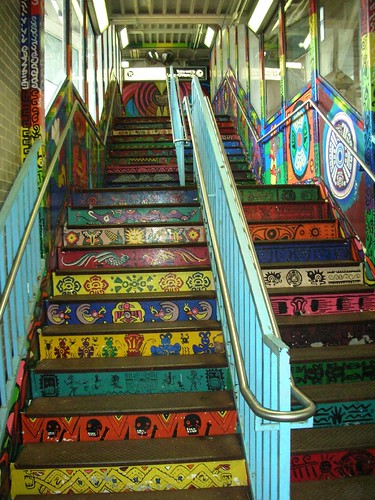
A suburb is an upgraded village: a spatially bounded space where people live under the illusion of knowing each other, of feeling protected by their belonging to the community, of fulfilling the middle-class (North-American) dream. You know the dream: a Stepford wife, a little box made out of ticky tacky (hope there are no hurricanes in your area!) in the middle of nowhere (preferably in a gated community, God forbids the coyotes or the immigrants come anywhere near us!), a Bimbo box (can't help but love Neal Stephenson's nickname for the SUV) where the Stepford wife can safely anchor the car-seats of the children (at least two, cause a). it's our Christian duty to reproduce ourselves, b). we 'all know' that the only-child comes with permanent psychological damage...).
One cannot understand the suburb and its mentality until one lives in North America. The suburb is a white, sanitized and monotonous place where everyone has to look the same, feel the same, behave the same. "We are in the Burbs, where it is better to take a thousand clicks off the lifespan of your Goodyears by invariably grinding them up against curbs than to risk social ostracism and outbreaks of mass hysteria by parking several inches away, out in the middle of the street (That's okay Mom, I can walk to the curb from here), a menace to the traffic, a deadly obstacle to uncertain young bicyclists." (Neal Stephenson, Snow Crash, 1992).
A true middle-class individual (and hey, everyone is middle-class in North America, except those who aren't, but even they are middle-class!) dreams of setting down, finding the Stepford wife (partner, to be politically correct) and buy that cardboard house with 5 bedrooms (guest rooms required!) for which they'll pay 10 times the actual price and probably 10 times what they can truly afford. A slave to the bank, a slave to the cardboard house, a slave to the bimbo box, the individual becomes a slave to the suburb mentality. The long commute downtown sucks. So many cars! The downtown sucks too: thank God we have a doorman at work, otherwise we would end up with the homeless begging right at the door of our office on the 100th floor of the prison - oops, meant office - tower. The lunch time rush to the unavoidable franchises sucks too: there are simply too many people, this city can't take any more foreigner, immigrants, minorities! We're already over-crowded!
The suburb is the place where mass hysteria grows out of conformism. Out of sanitized - yet worthless - environments, whose only value derives from the quantification of our middle-class desire: we're willing to pay hundreds of thousands of dollars for an ugly cardboard box that is worth shit just to live in a 'good community', where your neighbors have been selected by banks based on how intensely they desire to throw out of the window the money they don't have. The suburb hysteria comes in the forms of gates, of speed bumps and 30km/h speed signs. It comes in the form of community churches with stupid signs (Jesus loves you!), strip malls along the highway and yellow school buses. And it calms down at the sight of our trusted police buying their coffee at Starbucks; their mere presence, a token of suburb conformity itself, reassures us: they're here, we're protected from the awful unknown outside the suburb.
The suburb mentality is a dangerous one. It is an essentially anti-modern mentality, based on fear and born out of our capitalist desire to segregate ourselves from those who don't have the same earning-potential (under the false belief that earning potential makes us all the same). It's the belief of the capitalist slave, colonized by capitalism so that s/he no longer feels it as an ideological yoke, but as a free choice based on hard work (work hard, and you'll reach the stars; visualize, and you'll succeed).
The suburb mentality breeds fear, ignorance and intolerance. It breeds fascism. It prepares the mind for the radical populist-nationalist politicians who will shamelessly capitalize on the suburb hysteria to propel themselves to power. It makes people afraid, but more importantly, it makes them unable to cope with an urban environment, where good and bad co-exist, where people step on each others toes and parade their difference on a daily basis.
Photo credits: ulybug
Wednesday, October 27, 2010


Wednesday, July 28, 2010
The (Ideological) Dupes
I've been thinking a lot lately about what makes a statement racist. Is it the statement that is racist, the individual making the statement or the individual decoding that sentence? From a theoretical perspective, each of these three possibilities is tied to a particular understanding of the world:
Of course, there are always other options than these three. In fact, the mere fact that I only list three options here betrays a worldview: an understanding of communication as a message that moves from the source to the audience.
During these past few days, I was reminded of how complex the questions of 'what counts as racism' and 'where is racism located' are. Part of me, the politically engaged part, cannot escape the feeling that some of these experiences were clearly tokens of racism. But pinpointing exactly what made them so and how were they racist became increasingly difficult. I know that for some, things are easy to interpret: if it smacks of racism, then it is racism. But I'm a theorist, and nothing is simple for me.
I was reading a long and heated thread on Feministe. The topic - parenting - elicits everyone's opinion. Parents and nonparents alike, we all believe there's an objective 'proper way' to raise kids and integrate them in the pre-existing social setting. During this chaotic online conversation, someone qualified their statement as being true regardless of race, gender or ethnicity. In itself, this may be a reasonable statement: "I believe kids can misbehave, regardless of their or their parents' race, gender or ethnicity". As a performance, this kind of statement seeks to counter any accusation of racism, sexism or nationalism. The speaker seeks to reassure the audience that the statement is not uttered through the racial, gender or ethnic lens.
But the audience rejects this assurance. In fact, the audience is quick to point out that the statement itself is racist. Is anyone so deluded to think that normative statements about behavior can be uttered in a space devoid of race, class, ethnicity or gender? No, the mere fact that such a sentence is uttered only reinforces the audience's belief that it is actually racist, classist, sexist etc. No one who has been subjected to racism or to class-based discrimination would ever believe that such a sentence can be 'neutral' (if I may even use this qualifier) . It is uttered from a particular racial, ethnic, gender, class perspective - meaning, the person who utters it is probably white, middle-class.
By extension, all members of the audience who read that utterance and find it non-racist, non-sexist, etc. are themselves racist, sexist, classist etc. because they fail to recognize that the possibility of uttering such a statement is only opened for their class/ race/ ethnicity/ gender.
The other case is of a quite different nature, but it ends up pretty much in the same place. I see this person on a quite regular basis, without being friends or even acquaintances. We live in the same neighborhood and in time, we started saying "hello" to each other. One day, I saw a person that looked just like her, but yet a bit different. My friend confirmed the similarity. We didn't know if it's her or not; being confused, we focused on identifying her instead of being polite and missed the chance of greeting her - whether she was our neighbor or not.
The next time we ran into our neighbor, we told her the story and offered a variant to "save face": maybe it was her sister or a relative? No, she said. It's probably the fact that "all Asians look the same" she said, and then added: "But even my brother was convinced he ran into me once, and it wasn't me". She had offered us another "save face" variant, but one that didn't sit well with us because of its implications: we were white, and as the stereotype goes, "all Asians look the same" to white people. We protested the implied racial framing in a quite clumsy manner. But were we reading too much into it? Could it be that we were actually hearing what she said from a racial perspective? Could it be that the source of our confusion was a racialized vision in the first place? Did she mean it in a racist way or was she simply trying to be nice by offering a possible explanation? Would she have offered the same explanation if we were not white?
* * *
I do not sit well with the idea that we are always first and foremost making a statement from a racial, gender, ethnic, class position. While that's partly true and needs to be recognized and interrogated, it is not the whole truth. If we can think only "as whites", "as women", "as Americans", then we find ourselves in an impossible world, born into these pre-established categories and unable to truly understand each other. These being said, it is only a few of us that have the privilege (or maybe the burden?) of affording to question these things.
- a statement is racist --> words carry the meaning, people are simple filters through which these words circulate. Who carries the responsibility for being a racist here?
- the individual making the statement is racist --> the words we use reflect who we are on the inside. The 'racist' is a clear-cut identity inside us that is expressed through these words. In such cases, the individual carries the responsibility of being racist.
- the individual decoding/ interpreting the sentence is racist --> in this case, the individual interprets everything said through a racist lens. Everything makes sense to h/ir only through the racist perspective s/he espouses. Again, the locus of responsibility is within the individual.
Of course, there are always other options than these three. In fact, the mere fact that I only list three options here betrays a worldview: an understanding of communication as a message that moves from the source to the audience.
During these past few days, I was reminded of how complex the questions of 'what counts as racism' and 'where is racism located' are. Part of me, the politically engaged part, cannot escape the feeling that some of these experiences were clearly tokens of racism. But pinpointing exactly what made them so and how were they racist became increasingly difficult. I know that for some, things are easy to interpret: if it smacks of racism, then it is racism. But I'm a theorist, and nothing is simple for me.
I was reading a long and heated thread on Feministe. The topic - parenting - elicits everyone's opinion. Parents and nonparents alike, we all believe there's an objective 'proper way' to raise kids and integrate them in the pre-existing social setting. During this chaotic online conversation, someone qualified their statement as being true regardless of race, gender or ethnicity. In itself, this may be a reasonable statement: "I believe kids can misbehave, regardless of their or their parents' race, gender or ethnicity". As a performance, this kind of statement seeks to counter any accusation of racism, sexism or nationalism. The speaker seeks to reassure the audience that the statement is not uttered through the racial, gender or ethnic lens.
But the audience rejects this assurance. In fact, the audience is quick to point out that the statement itself is racist. Is anyone so deluded to think that normative statements about behavior can be uttered in a space devoid of race, class, ethnicity or gender? No, the mere fact that such a sentence is uttered only reinforces the audience's belief that it is actually racist, classist, sexist etc. No one who has been subjected to racism or to class-based discrimination would ever believe that such a sentence can be 'neutral' (if I may even use this qualifier) . It is uttered from a particular racial, ethnic, gender, class perspective - meaning, the person who utters it is probably white, middle-class.
By extension, all members of the audience who read that utterance and find it non-racist, non-sexist, etc. are themselves racist, sexist, classist etc. because they fail to recognize that the possibility of uttering such a statement is only opened for their class/ race/ ethnicity/ gender.
The other case is of a quite different nature, but it ends up pretty much in the same place. I see this person on a quite regular basis, without being friends or even acquaintances. We live in the same neighborhood and in time, we started saying "hello" to each other. One day, I saw a person that looked just like her, but yet a bit different. My friend confirmed the similarity. We didn't know if it's her or not; being confused, we focused on identifying her instead of being polite and missed the chance of greeting her - whether she was our neighbor or not.
The next time we ran into our neighbor, we told her the story and offered a variant to "save face": maybe it was her sister or a relative? No, she said. It's probably the fact that "all Asians look the same" she said, and then added: "But even my brother was convinced he ran into me once, and it wasn't me". She had offered us another "save face" variant, but one that didn't sit well with us because of its implications: we were white, and as the stereotype goes, "all Asians look the same" to white people. We protested the implied racial framing in a quite clumsy manner. But were we reading too much into it? Could it be that we were actually hearing what she said from a racial perspective? Could it be that the source of our confusion was a racialized vision in the first place? Did she mean it in a racist way or was she simply trying to be nice by offering a possible explanation? Would she have offered the same explanation if we were not white?
* * *
I do not sit well with the idea that we are always first and foremost making a statement from a racial, gender, ethnic, class position. While that's partly true and needs to be recognized and interrogated, it is not the whole truth. If we can think only "as whites", "as women", "as Americans", then we find ourselves in an impossible world, born into these pre-established categories and unable to truly understand each other. These being said, it is only a few of us that have the privilege (or maybe the burden?) of affording to question these things.
Thursday, July 8, 2010
On Snow Peas and Normality
 As I child, I learned that peas were to be unshelled, boiled and then eaten as a side dish. Nobody cared about the shells; we simply discarded them. The real prize was the small, green and round pea. Nobody would think of eating them raw.
And so I grew up thinking I know what peas are and how you should eat them. Of course, there were variations in terms of the recipes one used to cook them. But the basics stayed the same: unshell and boil.
Little surprise that when I first saw someone eating a raw pea pod, I was taken aback: how could they do it? It contradicted everything I knew about peas. More than that, it contradicted a shared norm of eating and cooking peas. How could they eat a raw pea pod when everyone knew peas had to be boiled and the shells had to be discarded? Eating them raw was simply 'abnormal'.
Curiosity aside, my stomach also decided to make a stand. As it grumbled at the thought of putting a raw pea pod in my mouth, it reinforced my decision on eating raw peas: abnormal. It just wasn't right and my stomach simply knew it!
Normality was thus born as a seemingly biological thing: eating raw peas is not good for you, and that was the end of the story. The fact that so many other people did not seem to buy into this normality wasn't disconcerting. After all, the world is full of exotic and eccentric people! I knew what was 'normal' and I was gonna stick to it because that was the right thing to do!
We often fail to see that 'normality' is contextual: it becomes 'normality' by virtue of being accepted and enforced by those around us. Confronted with difference, we become rigid and loose our curiosity, hanging on to that false sense of self-reinforcement that 'normality' brings along. What counts as 'normal' when it comes to food is even trickier, as I wrote a long time ago, mostly because growing accustomed to a type of food becomes intertwined with our sensations and biological reactions. Even today, when I know that snow peas can be eaten raw, my stomach still protests to the idea, making it quite easy to forget that this reaction is part of a long process of socialization, that shaped my taste buds but also my sense of 'good food'.
Photo credits: Snow peas by little blue hen
Wednesday, June 2, 2010
Letter to my radio station: Good bye, au revoir, arrivederci.
Dear radio station,
I am leaving you. I know you don't really care, because you probably have hundreds and thousands of fans. But I'm sick and tired of your constant repetitions and redundancies. How about you give me some 'diversity'? It's not that I don't like Beyonce. But listening to her latest song (which incidentally, was produced by the same owner that owns you, my dear radio station) 30 times a day feels a bit like brainwashing. Maybe it wouldn't hurt you, dear radio station, to tap a bit into the wealth of music that's being created out there, outside the studios of your owner. Maybe, just maybe, you'll find that there's actually rhythm and emotions that do not need to be in English - or whatever your 'official' language is.
I'm dreaming, I know. Who on earth wants to hear Stromae when Adam Lambert is playing on American Idol? And why would you ever trade the daring Lady Gaga for Manu Chao (yeah, yeah, I know, it's distracting that he keeps on switching from one language to another)... Hey, it make more sense to hum "my hump, my hump, my hump" than "we no speak americano"...
So, my dear radio station, I'm leaving you. I'll come visit you once in a while, mostly in the morning when you pretend to give me the 'news'. But for the rest of the day, I'm switching over to my own list of songs. It's still Anglophone, I know. But I'm working on it every day, collecting more of the sounds that make me wanna dance. I'm kind of sick of all the crap you throw at me. Good bye, au revoir, arrivederci...


I am leaving you. I know you don't really care, because you probably have hundreds and thousands of fans. But I'm sick and tired of your constant repetitions and redundancies. How about you give me some 'diversity'? It's not that I don't like Beyonce. But listening to her latest song (which incidentally, was produced by the same owner that owns you, my dear radio station) 30 times a day feels a bit like brainwashing. Maybe it wouldn't hurt you, dear radio station, to tap a bit into the wealth of music that's being created out there, outside the studios of your owner. Maybe, just maybe, you'll find that there's actually rhythm and emotions that do not need to be in English - or whatever your 'official' language is.
I'm dreaming, I know. Who on earth wants to hear Stromae when Adam Lambert is playing on American Idol? And why would you ever trade the daring Lady Gaga for Manu Chao (yeah, yeah, I know, it's distracting that he keeps on switching from one language to another)... Hey, it make more sense to hum "my hump, my hump, my hump" than "we no speak americano"...
So, my dear radio station, I'm leaving you. I'll come visit you once in a while, mostly in the morning when you pretend to give me the 'news'. But for the rest of the day, I'm switching over to my own list of songs. It's still Anglophone, I know. But I'm working on it every day, collecting more of the sounds that make me wanna dance. I'm kind of sick of all the crap you throw at me. Good bye, au revoir, arrivederci...

Tuesday, May 4, 2010
Are we becoming more conservative?
 It's nice that we can write blogs and tell everyone who cares to read what we stand for. Or analyze the latest trends, crazes and ideas. It's nice that we can express ourselves and find other people who care to comment. Or not. But in the end, does it really matter? I mean I'm most likely to read the bits and pieces that already fit my values and worldviews. What I read adds to what I already think, but it doesn't change it.
If I am against abortion, I probably won't be reading Feministe (unless I want to trash them). And, it turns out, more and more young women are against abortion. I'm speechless. I simply cannot understand how a woman can be against abortion - unless she's brainwashed by religious beliefs. After all the fight that previous generations had to put up to get to the point where a woman could claim her right to her own body, some still fail to understand the importance of this right. And the price some people had to pay for it. Fighting for the right to abortion does not mean that all women get pregnant and have an abortion. It's like saying 'we are against condoms, because they encourage promiscuity'.
And if I am against abortion, it's most likely that I believe in the sanctity of my cause. Each year, some students in an university in a conservative city put up billboards on campus that equate abortion with genocide. The images are graphic, the students are believers. I'm speechless again. How can it be that students, who used to represent the revolutionary wave, have become the prophets of intolerance, blind faith and conservatism? Their 1968 French fellows must be really disappointed... Students used to represent the commitment to critical thinking and reason (I know, a heavy concept, but maybe it's time to reclaim it). Not anymore. Not since the university has become the labor-processing plant, serving the needs of governments and industry. Critical thinking is a dying breed - nobody needs it anymore.
Photo credits: Liverpool Street Station by victoriapeckham
Wednesday, March 10, 2010
What's wrong with day care?
 I was once told that you should keep your child at home rather than send her to day care.
I do not fully understand the day care system, but I wonder why some people see day care as such a bad thing for their kids.
I'm pretty sure the idea that a woman has to be a mother first and foremost, and therefore tend to her kids is still strong. Although many women feel this to be something biological, it is not. It has to do with social factors, with being taught from an early age that a girl cares about the babies, that a woman has to be a mother, and so on.
But beyond the gender discourse, I think this fear of day care also has a lot to do with the day care/ kindergarten system in North America. As said, a system I still don't fully understand: what's the difference between them? Are these institutions public or private? Are people working there educated and licensed? Why some institutions are affiliated with churches? How come day cares are in private homes? Who decides on the curricula?
I mean, I do understand the historical circumstances and the institutional dimension, but I think it's simply wrong. And if you really espouse gender equality, you need to ensure that there is a reliable, secular education system where kids can develop intellectually and emotionally.
I grew up in a different part of the world and went to kindergarten. Our kindergarten was a huge brick building, with a big backyard and a wonderfully huge swing. Oh yes, small kids were allowed to use the swing... That was back in the time when kids were supposed to fall and hurt themselves. I did fall, and I did hurt myself but I survived and not really cared about it.
Our kindergarten had nice and not-so-nice teachers. Mostly women, it is true. But they were all educated and they all made sure our day was neatly divided into play time, learn time, eating time and nap time. I really really hated the afternoon naps.
Each morning, we would have breakfast there. That's when I met my friend M, who always skimmed the milk for me. Yes, that was during the time when milk came with all the natural fat and formed a disgusting creamy skin on top when warmed up.
We then went to our different classrooms and played. I had to learn that one doesn't always get what one wants. And that playing involves taking other kids into consideration. I also learned that I'm not very good at fighting for my toys, but that if you annoy me, I'll make sure I get what I want from you.
We also drew a lot of pictures and sang songs and learned funny things that make kids happy. A very important gift that I got in kindergarten was an extensive range of those annoying diseases kids get. They are to be experienced when you're young enough not to remember them.
My mom picked me up at 4.30 pm. Some days she was late, and I was crying my heart out fearing she has abandoned me. I survived, and I wasn't permanently damaged by my tears.
The point is: the kindergarten was a place that parents trusted. The stay-at-home mom was rare and usually frowned-upon: why was she at home instead of working? They never gave us junk to eat. They insisted on our morning milk and our afternoon veggies. We did NOT watch TV. We played with toys and with each other. We played outside almost every day, summer and winter. Yes, kids cried in the morning because they wanted to stay at home. But hey, it was a great lesson in growing up. And I made a friend for life there. So I guess in the end, it was actually good for me.
Photo credits: Seattle Municipal Archives
Tuesday, February 2, 2010
Facebook Intolerance
 Your friend's friend makes an intolerant comment on your friend's profile. It's highly offensive, almost bordering fascism from your point of view. But you are not sure what to do. It's not addressed to you, but it's in a cvasi-public space - a friend's wall. You do not know that person, but in a way it's just like being in a shop and witnessing a blatantly intolerant act. What do you? Do you comment? Or do you ignore it? Should you tell yourself it is just a private comment? Or should you rather respond to it, precisely because if a private comment in a public space remains unaddressed, it may look like everyone else endorses it?
Friday, January 22, 2010
Speaking Chinese...
 "You're speaking Chinese again", a friend told me the other day. I wasn't actually speaking Chinese, but in the language she was using, 'to speak Chinese' stands for saying something that cannot be understood. It's an idiom, but a revealing one. The way we speak, even if we do not mean it, often indicates a variety of things:
 - how certain groups or certain differences have been constructed in that language and the ethics surrounding this construction;
- how we, as individuals, may consciously or not buy into these constructs, often perpetuating a problematic construction of difference as something to be feared, as something that cannot be surmounted, as something that has to be avoided at all costs.
This is an interesting construction of difference - and I'd be curious to hear if this idiom has any sense at all in English or if readers can relate to it in any way. Here, difference comes to stand for something so apart from our ways of understanding the world, that it can no longer be made sense of.
As we learn our languages, with their biases and suggested views of the world, we also learn how to categorize the world. With this problematic idiom, Chinese comes to constructed as something incomprehensible. It is an exotic Other with whom we can have little if any rapport.
Such a viewpoint may often frame the way we come to relate to individuals we identify as belonging to the group. Often times, the incomprehensibility becomes a source of patronizing irony: "It's in Chinese, so you won't understand a thing, but it sounds so funny!". If you've ever seen someone of Asian background for whom English is not the first language trying to explain something, while other English speakers keep laughing at every word, then you know what I'm talking about. It is interesting though to think about how our perception of difference is informed by such an intricate web of cognitive, linguistic and social dynamics.
Photo credits: Steve Snodgrass
Thursday, January 21, 2010
When the French need to prove they're French...
 Who decides on your race, ethnicity or nationality? What are the features you need to have in order to be placed in one of these categories? While I am usually more concerned with deconstructing such categories and with showing how unsustainable they are, this post will be slightly different.
A few days ago, TIME published an interesting story on how the French must prove they are French. The idea was that children born abroad to parents that were French nationals are having a hard time getting their nationality recognized by France. If this nationality is not recognized, then you cannot be a French citizen. However, to be recognized as such, you need to be either born out of French parents, or to be born and to have lived in France until you reach adulthood. The TIME story traced the saga of one of the children born outside of France from French parents who were working abroad at the time.
Without getting into the intricacies of the law here, it is interesting to observe the struggle around defining what nationality is, who has the authority to recognize it and by what means it can actually be attained.
Nationality is a notoriously hard to define concept. Back in the 1950s, Karl Deutsch defined it as "a term which may be applied to a people among whom there exists a significant movement toward political, economic, or cultural autonomy” (1953, p. 3). There were obvious problems with this definition, and Deutsch was the first to notice that: just how do you measure that? It is fine to say "a people with a common will to being autonomous", but just what does the 'common will' mean here? Do you count those who are not in favor of that autonomy? Do you count those who do not recognize themselves as belonging to the group in question, but still live with the group?
And even if you come up with seemingly more 'objective' features to define nationality, such as language or common history, you're in trouble again. For instance, language is not as uniform as we want to believe it. In fact, language is better understood as 'languages', where the plural emphasizes the lived diversity of spoken dialects.
However, trying to understand 'what nationality is' is by far less interesting than trying to understand 'how nationality becomes the main principle of categorization' within modern world. Since most people are social beings, they have always lived in groups. What's different in modernity is the nature of the group boundary as well as the importance of the group as an essentializing force acting upon the individual. To the extent that nationality becomes the political principle justifying the organization of the state, nationality also becomes the most important category defining who is in and who is out, who has access to resources, and who has rights or not.
The overlap between nationality and the monopoly of authorized violence (the state) is the most intriguing and the most problematic one. With this overlap, the main authority in placing you within groups resides with the state. The state takes over the possibility of negotiating this placement in everyday life and rigidifies it into a set of rules that establish your location within a system of rights and exchanges.
Photo credits: fdecomite
References: Deutsch, K. (1953) Nationalism and Social Communication. An Inquiry into the Foundations of Nationality. NY: The Technology Press of the Massachusetts Institute of Technology & John Wiley & Sons, I nc.; London: Chapman & Hall, Ltd.
Wednesday, January 20, 2010
Gender and Sexuality in Advertising
The commercial says: "Be smart. Be attractive to the opposite sex!"
What is this commercial about? You have three guesses:
- Excel, the gum that whitens your teeth.
- Toyota, the car that makes you socially desirable.
- London School of Economics, the higher education institution that makes you very employable.
If you guessed "Toyota", then you've got it! Not because there's something intrinsic to Toyota (the car or the brand) that makes you both smart and sexually attractive. But because the advertising/ marketing team has decided that wits and sex cannot possibly go wrong. Who doesn't want to have them both? And if all you need is a car, then hey, I'm in! The political correctness of this commercial - as well as its stupidity, unfortunately the two go hand in hand here - was compelling. It's a little treasure, revealing how intellectual concerns and criticisms about economic issues make their way back into the world of economics and get reincorporated in the economic logic of profit making.
This commercial may be a nice example of what sociologist Anthony Giddens has once called the reflexivity of the modern world:
“The reflexivity of modern social life consists in the fact that social practices are constantly examined and reformed in the light of incoming informatoin about those very practices, thus constitutively altering their character.” (Giddens, 1990, p. 38)
When some consumers get upset or feel left out, the good advertiser knows that all you need is a re-branding, the miracle touch that transforms the gender-oppressive product into a gender-bender, gender-celebratory one.

- Buying the product gives you the two things feminists have nagged us about: sexual attractiveness and intelligence. Because we all know how hard it is to be both smart and attractive. Yet, with this product, the two become seamless.
- The product is not designed exclusively for men or women. And while it is unfortunately still designed for the heterosexual group (I guess the creative team could not come up with a word that would please everyone... And you have to agree that 'Be attractive to whomever or whatever you are attracted to' does not really sound very neat...), both men and women can benefit from its magical, sexual effects. No more "Mini-Cooper is a car for gays" or "VW Beattle is car for women"... No, sir/mam, this car's magic bestows sexual attractiveness in a (almost) politically correct manner.
References: Giddens, A. (1990) The Consequences of Modernity. Cambridge: Polity Press, 1990
Friday, January 15, 2010
Motherhood
 When asked what she is doing, an acquaintance answered she is a mother. And added: "The best thing a woman could be". I had to disagree. As a child, I always wanted to hear my mom say that I am the best thing in her life. But growing up, I started to think that my mom was so much more than just my mom: she was a professional, she was an intellectual, she was a human being whose life extended beyond her role as a mother. My mom took pride in who she was, as a human being. And I am thankful for this, because it taught me that I am first and foremost a person. That biological sex is one of the many aspects of my life, and it needs not be the one that totally defines me.
It's true that being a mother is not easy. Nor does it come naturally. Like all other things humans do, it requires learning. To master it, you need to practice and to be patient. You rely on the existing knowledge, you seek information and you adjust what you find out to fit your view of the world. If anything, one can say that being a mother - better, being a parent - is one of the toughest jobs ever, because there's so much at stake. Not to mention that it is a round the clock, year round job. And that it never really ends...
But being a mother is not "the best thing a woman could be". It may be your personal calling, but that's not a consequence of you being a woman. It is the consequence of a choice you made, a choice stemming from your worldview. Women are not one and the same, defined by their capacity to procreate. Not all women are able or want to have children. Does that mean they will never reach their potential as human beings?
We all try to make our own choices about our lives. But to say that motherhood is the best a woman could be is highly problematic. You may say that motherhood is the best thing you chose to be, because it fulfills you. In such cases, you want to convey to others that you are happy and satisfied with what you have in your life. But one size does not fit all!
Photo credits: seanmcgrath
Monday, December 21, 2009
Negotiating Name-Calling
 Warning: The contents of this post may be offensive. Or maybe not. Maybe it's just my political correctness. I may become 'old school': the kind of people who tried to fight consciously and unconsciously abusive labels and name-calling. But as the fight unfolded, so did a form of resistance that sought to reclaim the labels and to reinvest them with a new, empowering meaning.
 The other day, I was looking for an unprotected wireless internet network that I could use for a mobile device. In the middle of a commercial area, the only unprotected network available was "niggerfaggot". I was taken aback: how should I read this? Could I read it in any other way than being utterly offensive? Did I even have the right to 'read' it in the first place, given that it most probably meant to be private? And what was I supposed to do about it? Report it? Connect to it? Ignore it?
I decided not to use the network. But my feelings didn't vanish: uncertainty, anger, wonder. Mostly uncertainty. What was the name's meaning? What was its role? We all name our technologies: my car's name is Sharky, mainly because it resembles a shark from the profile. Sometimes, the name is meant to be a joke. Which in itself doesn't mean the joke may not rest upon ethnic, racial or gender stereotypes.
We are meaning-making creatures: unless we make sense of things, we cannot move on. How am I to make sense of a network named "niggerfaggot"? What sets of criteria should I use to interpret it? Let's pretend for a moment that the name is reclaimed by someone who wants to challenge the mainstream hateful connotations of the words. Does this moment of personal empowerment matter in terms of the system? Would people sense the alleged irony or resistance?
The construction of difference is not something stable or unitary. It remains contextual: to understand, you need to know the context of the name. It also remains fluid over time: today's discrimination may be tomorrow's resistance. But most importantly, it remains historical: you need to understand the way in which the name was used throughout time to mark a particular type of difference.
Photo credits: Kelly Santos
Wednesday, November 25, 2009
Everyday Inconspicuous Discrimination
At the lab were I usually get my blood tests done, there is a person of the same nationality as me. We have never been 'properly introduced'. The first time I went to the lab, this person overheard me speaking the language and immediately jumped into the conversation. Like when you travel abroad, and someone overhears you speaking the same language and they immediately feel an imaginary (yet hardly real...) connection. They feel you share something, although you are complete strangers. They want to establish rapport, although given the same situation in your own country, they'd never approach you.
But how can you tell such persons you are really not interested in establishing rapport just because you happen to speak the same language... After all, you so happen to speak this language with some other 29 million people but you do not have a relationship with each and every one of them. Frankly, you probably don't even want that.
Yet, when someone tries to be nice, regardless of the reason, it's hard to be rude. Hard to tell them: You know what, I don't know you and frankly, I'm not really interested in knowing you just because we speak the same language, have the same skin color or drive the same car. How can you tell them that in fact, what drives them to approach you is annoying and offending, because it discriminates? Because it identifies you a priori with something you may not be, feel, share or want? Because it categorizes people, and you don't support that?
Funny thing is, every time this person realizes we speak the same language, they try to be extra kind, to serve us first, to bypass the lineup. All just because we happen to speak the same language. I know this seems insignificant, but let me assure you it is not. It is at the root of many discriminatory practices; and with time, such practices became institutionalized networks of influence and distribution of resources. Their discriminatory core becomes obscured; all it's left is the result: discrimination.
But how can you tell such persons you are really not interested in establishing rapport just because you happen to speak the same language... After all, you so happen to speak this language with some other 29 million people but you do not have a relationship with each and every one of them. Frankly, you probably don't even want that.
Yet, when someone tries to be nice, regardless of the reason, it's hard to be rude. Hard to tell them: You know what, I don't know you and frankly, I'm not really interested in knowing you just because we speak the same language, have the same skin color or drive the same car. How can you tell them that in fact, what drives them to approach you is annoying and offending, because it discriminates? Because it identifies you a priori with something you may not be, feel, share or want? Because it categorizes people, and you don't support that?
Funny thing is, every time this person realizes we speak the same language, they try to be extra kind, to serve us first, to bypass the lineup. All just because we happen to speak the same language. I know this seems insignificant, but let me assure you it is not. It is at the root of many discriminatory practices; and with time, such practices became institutionalized networks of influence and distribution of resources. Their discriminatory core becomes obscured; all it's left is the result: discrimination.
Monday, November 23, 2009
Techie Complaints...
While women sang, acted in dramas, and played music on radio, there were few women announcers in the early days of broadcasting. This was partly because so many stations were one-man bands where the announcer was also the engineer and manager, and partly because station owners thought men's deeper voices lent more authority to broadcasting (Nash, 2001, p. 45)
Jane Gray became one of the first female broadcasters in Canada. She began by reading poetry in 1924, but was discouraged by her husband, her priest and the radio station owner "who told her that women belonged at home, not on the air" (Nash, 2001, p. 45). By the 1920s- 1930s, she became the most prominent female broadcaster in Canada.
I like these reminders of how women and technology became separated throughout history. It helps me understand why, in spite of the gender equality awareness today, women still feel a world apart from technological processes. I know many women who love using gadgets, but could not be bothered with their inns and outs. Fair
 enough, they don't care. As long as the tool works, as long as it serves its ends, everything's fine.
But it's not. A tool works in particular ways, for particular purposes, with particular methods. On a general level, not being interested - and not understanding these inns and outs - also means buying into what is already pre-established as a your role vis-a-vis that technology. And, if you choose not to use them (partly because you cannot buy into their pre-established purposes, routines and impositions upon you), you're out of the (social) loop.
Often times, what bothers me most is not being able to do stuff with my computer. I mean, real stuff. Of course, I use it. And I probably know a bit more than just writing a text or putting up a powerpoint presentation. But that's not the stuff I want to do: for instance, I'd really like to be able to write an avatar-creation soft that would allow us to customize avatars beyond gender stereotypes.
But just like early female radio voices, relegated to the status of melodic entertainment but not allowed to enter the serious arena of authoritative broadcasting (read news, politics... serious stuff...), with digital technologies women are often relegated to the status of users. Maybe producers of 'soft content' - blogs, social networking sites, uploading photos, sharing what the kid had for lunch with the extended network, checking the latest health news.
But when I think of software or hardware producers, all I can see in the back of my mind is a male-dominated world. I may be wrong. It may all be just a stereotype. But, just as the radio station owner who told Jane Gray that women belong at home and not on air expressed the prevailing reasoning of his time, my stereotypes feed from a world of imagery constructed by the social norms at play within my social environment. There may be lots of female soft/hardware developers out there, but we often do not think of them as legitimate players in the field. More likely, they're exceptions...Like Sandra Bullock in "The Net"...
References
Nash, K. (2001) The Swashbucklers. The Story of Canada's Battling Broadcasters. McClelland and Stuart Ltd.
Photo Credits
The US National Archives
Tuesday, November 17, 2009
Consuming Diversity
 One of things I like when visiting a metropolis is its diversity: you can have lunch in Chinatown and dinner in Little Italy. Everywhere you walk, diversity surrounds you. I qualify as a 'diversity-seeker', a person who actively looks for diversity.
But what exactly do I do with this diversity? And how does this inclination of seeking diversity translate in terms of social engagement, social practices and social ties?
Well, according to a recent study published in the Journal of Ethnic and Migration Studies, diversity-seeking may translate into ... well, consumption of diversity. But from consumption to engagement with difference it's a big step, one that involves challenging your own routines and values, re-adjusting your own expectations and practices, and striving to open yourself up instead of closing yourself down to difference.
Blokland and van Eijk (2009) have studied the residents of a small neighborhood in Rotterdam (the Netherlands), asking some pre-determined questions on their attitude to and engagement with diversity. The neighborhood in question is an ethnically diverse one, recently transitioning from being perceived as a 'bad' neighborhood to being perceived as a 'cool' one, with small shops and fancy restaurants.
Although the study itself remains limited by the pre-determined set of questions that were asked of people (we do not know how people themselves made sense of their own position in those neighborhoods and their own relation to diversity), it is interesting to see that what diversity-seeking often translates into is consumption:
Diversity-seekers frequented restaurants, bars and shops more intensely than other residents, but did not show more (or less) social or political engagement with local neighbourhood affairs than other residents.The article itself is responding to Richard Florida's now famous discussion of the rise of a new middle-class, the creative class, roughly defined by its involvement in creative industries. The creative class, Florida contends, is more inclined to be tolerant and to seek diversity in their residential locations. But exactly what does 'seeking diversity' means remains an open question: just because one eats Chinese food and drinks Greek ouzo doesn't necessarily make that person more willing to question hi/er belief system and daily practices. Blokland and van Eijk (2009) echo this when they conclude that
a taste for diversity means little to social network diversity. As far as diversity is brought into the practice of daily life, using cmmercial neighborhood facilities is all that diversity -seekers do more... even for those who, whether middle-class or not, come into a mixed neighborhood with openness to diversity, this openness does not translate in more diverse networks (p. 327).
As I said, there are limitations to this study. In fairness, it sheds little light on how people actually relate to diversity, beyond statistically correlating their demographic data with their answers to some pre-determined questions that the authors take as measuring diversity in our lives. In my building, there are at least three or four recognizable ethnic groups. I do not socialize with my neighbors simply because the way I come to make friends involves an intellectual rapprochement, and it's hard to have that interaction with one's neighbors out of various reasons (including the Western attitude towards sharing an urban space). Yet, the study does bring forward an interesting observation: that consumption of diversity does not equal living with diversity.
Photo credits
Puroticorico
References: Blokland, Talja and van Eijk, Gwen(2009) 'Do People Who Like Diversity Practice Diversity in Neighbourhood Life? Neighbourhood Use and the Social Networks of 'Diversity-Seekers' in a Mixed Neighbourhood in the Netherlands', Journal of Ethnic and Migration Studies, 36: 2, 313 — 332
Friday, November 13, 2009
The need to classify
We classify. Maybe because we want to master the world around us, by putting order into it. Maybe because our brains work with a tree-like structure, placing things into categories and drawing branch like relations between them. We classify, and in this process we buy into the order of things*: we accommodate things within a pre-determined system of beliefs and interests that underlies every classificatory order.
No classification is innocent.
- I'm going to a concert tonight. There's a famous piano-player from Canada playing.
- What's her name?
- Sarah Cheung.
- Oh, she's Asian then.
- She's quite famous in Canada.
- Yes, of Asian origins. Cheung does not sound ... well, how shall i put it, Canadian.
- It may not sound Western.
- Yeah, that's what I meant.
Canadian, Asian, Western... we need to put people in categories. It's not enough to say what a person does or where a person now lives. To properly place that person in our nicely fitting systems of categories, we need to find out "where is s/he coming from". As if, by ticking the little box of birth-place and/ or ethnic group, all of a sudden there's order. And we can breath out, relax and hear the rest of the conversation.
*The Order of Things is the title of one of Michel Foucault's books, dealing with the relation between power and knowledge.
No classification is innocent.
- I'm going to a concert tonight. There's a famous piano-player from Canada playing.
- What's her name?
- Sarah Cheung.
- Oh, she's Asian then.
- She's quite famous in Canada.
- Yes, of Asian origins. Cheung does not sound ... well, how shall i put it, Canadian.
- It may not sound Western.
- Yeah, that's what I meant.
Canadian, Asian, Western... we need to put people in categories. It's not enough to say what a person does or where a person now lives. To properly place that person in our nicely fitting systems of categories, we need to find out "where is s/he coming from". As if, by ticking the little box of birth-place and/ or ethnic group, all of a sudden there's order. And we can breath out, relax and hear the rest of the conversation.
*The Order of Things is the title of one of Michel Foucault's books, dealing with the relation between power and knowledge.
Thursday, November 12, 2009
Personal Globalization
Warning: The following notes smell like middle-class, I-have-it-all, I-can-afford-to-be-cosmopolitan bragging... not my intention, but the smell persists...
 The other day, a friend from Romania asked her network on Facebook to vote for a band in Germany. She's dating one of the members of the band, who's also from Turkey. Funny things is, me and this friend met in Turkey... the Westernized, touristic part of Turkey where people go to forget their frustrations and enjoy life by the sea, sipping on a margarita. That part of Turkey where's water in abundance and where everything is white and neat, just like the tourists... What stayed most with me however was the overwhelming feeling I had stepping into the Istanbul bazaar... Istanbul
 Istanbul: There was this person I knew from Istanbul whom I actually met in the subway in Budapest. I was talking to a friend of mine who happened to be from Greece, and just like in a comedy of errors, this guy thought we were talking about him. The friendship between a person from Athens and one from Istanbul, as unlikely as it sounds to some ears, was actually a natural... Friendship
Friendship: So was the friendship between this person from Athens and a person from Skopje. Hey, who would have every thought... There's nothing more powerful in destroying ethnic stereotypes and nationalisms than friendships. The three of us formed a trio, always together - also known as "The Triplets"... Triplets
Triplets: Having triplets is no easy job, but for my friends it looks like a piece of cake. You'd think having three kids at once would transform the mom into a perpetual slave to diapers and baby food. Not this mom... She's just amazing, travelling almost every month to Strasbourg and Bruxelles. Hey, the European Union itself is asking for her! So she goes to beautiful Bruxelles, to mingle with all of those politicians and bureaucrats we only get to see on TV... When we visited Bruxelles, my mom told me: "Look, we are now running around in the backyard of Europe". Not quite a 'backyard', but still a huge, white (here comes whiteness again...) meeting place. A place where my former colleague, who so happens to be from Bulgaria, shops for fine chocolates and gateau aux abricots... Bulgaria
Bulgaria: I owe a huge debt to a person from Bulgaria, who once had faith in me and told me "you can do it". So did a person from Hungary and two from Norway: they gave me courage and skillfully guided me through the jungle of social theory. Theory and morality. Just and unjust wars. Social responsibility and peace. Peace
Peace: Peace is exactly what my friend from Kenya hopes and lives for. But when you work in a conflict area, thousands of miles away from your own family, peace seems like a rich-people privilege... My friend tells surreal stories about kidnappings, gun-attacks and violence. And I can only listen, a world away, hoping somehow nothing will touch my friend and the world will get a better place.... Cheers to bourgeois ignorance... I once had a roommate from that area. I remember she had never seen snow in her life before we were in Norway. But then again, neither did my friend from Athens - though it so happens that after we saw snow in Budapest, Athens all of a sudden started getting snow... Blame it on the climate change. Climate change
Climate change: My friend from Costa Rica keeps a calendar of the days left til the Copenhagen Summit on Climate Change. It's a one-person fight: every day, he reminds all his friends of the summit and of climate change. Every day, he asks us to think about what each and every one of us could do to change things. It's like a daily mantra we came to expect: tell us something about climate change. And it works for us, his friends... Friends
Friends: My friends are spread all over the world. And if I'm to add my acquiantances to my network of friends, I get to cover quite a lot... From Asia to Europe, from Australia to North America, from Africa to ... well, what's left? Hm, no friends from the two Poles, though I can still brag with some friends who live above the Polar Circle...
Monday, November 9, 2009
Be polite, or we'll know exactly which group you belong to...
I went to a see a play the other day. Though marketed as a comedy, the play was in fact quite heavy: troubled relationships, troubled lives and the past haunting the present, delivered to the audience in a funny wrapping. And the thirty-something people in the audience laughed here and there, whenever appropriate. Except one. One person laughed at the... er... wrong times?
You know the type: usually in the middle of the room, this person has obviously got it all wrong. They never laugh when everyone else is laughing; they laugh on their own, as loud as they can, enjoying themselves, oblivious to the annoyance they bring upon you...
What's wrong with them, why don't they get it?
But it's so easy to get annoyed with other people, to see the wrongs in them... If only they would follow the rules... the norms... the conventions...
Because, in the end, that's all it comes down to: rules, norms and conventions. Social rules around what is appropriate behavior during a play. Social cues to be read in the play, in the actors' behavior. Social conventions defining what counts as funny, appropriate, acceptable. And laughing on your own, finding your own relationship to a play and to its meaning, that's just not 'legitimate' with us: you have to laugh when the others are laughing, and you have to clap when the others are clapping...
Have you noticed that nobody - and I mean Nobody! - throws rotten tomatoes at actors anymore? Or that nobody shouts at them "You suck! Find another job!" (only Simon Cowell still has that privilege...)? Oh, that would be funny... I fantasized about that during quite a few performances... but I would never have the courage to break the social rules of legitimate behavior. I missed my chance with some hundred years... ah, the time when audiences chatted during a play (gosh, imagine the disorder!) or when they "hooted and jeered" (Gossett, p. 174).
The unwritten yet powerful rules of politeness and legitimate behavior. We can't do without them (really, don't start throwing rotten tomatoes at people you don't like, ok?). Yet they also hide away the real lines of separation under the veil of 'appropriate behavior'. Separation along class lines or majority/minority lines, when the you just 'know' from a person's reaction that s/he's not 'well-mannered' or 'from here'.
Norms, rules, conventions, symbols, words, ways of talking - all of these form for Pierre Bourdieu the 'symbolic capital' through which we communicate. The currency we use to obtain other people's endorsement, support or even love. They position us in the social hierarchy. Our use of them reveals us as 'insiders' or 'outsiders', as 'powerful' or 'power-hungry'.
And it is not only speech - the choice of words, the way you construct a sentence, a.s.o - but also gestures, postures, proximities; we rely on them to communicate with others. They position us in particular nodes of power structures; and we use them as guides in interpreting other people, in positioning them within the social hierarchy.
In fairness, this time I actually enjoyed this lonely audience member's laughter. But most of the times, I resent it. It's hard to move beyond the resentment: it's way easier to study the social norms and their power dimensions than it is to actually live with them. But I suspect the hardship comes from the rather rigid boundary social groups have constructed around them. Any tresspassing of the boundary, of the 'common sense' and 'social expectations' is troubling and distressing. And it's always easier to point to the "Other" as an "Other", than to be suspicious of your own labelling of people.
References:
Bourdieu, P. (1991) Language and Symbolic Power. Cambridge: Polity Press
Gossett, P. (2006) Divas and Scholars: Perfoming Italian Opera. University of Chicago Press
You know the type: usually in the middle of the room, this person has obviously got it all wrong. They never laugh when everyone else is laughing; they laugh on their own, as loud as they can, enjoying themselves, oblivious to the annoyance they bring upon you...
What's wrong with them, why don't they get it?
But it's so easy to get annoyed with other people, to see the wrongs in them... If only they would follow the rules... the norms... the conventions...
Because, in the end, that's all it comes down to: rules, norms and conventions. Social rules around what is appropriate behavior during a play. Social cues to be read in the play, in the actors' behavior. Social conventions defining what counts as funny, appropriate, acceptable. And laughing on your own, finding your own relationship to a play and to its meaning, that's just not 'legitimate' with us: you have to laugh when the others are laughing, and you have to clap when the others are clapping...
Have you noticed that nobody - and I mean Nobody! - throws rotten tomatoes at actors anymore? Or that nobody shouts at them "You suck! Find another job!" (only Simon Cowell still has that privilege...)? Oh, that would be funny... I fantasized about that during quite a few performances... but I would never have the courage to break the social rules of legitimate behavior. I missed my chance with some hundred years... ah, the time when audiences chatted during a play (gosh, imagine the disorder!) or when they "hooted and jeered" (Gossett, p. 174).
The unwritten yet powerful rules of politeness and legitimate behavior. We can't do without them (really, don't start throwing rotten tomatoes at people you don't like, ok?). Yet they also hide away the real lines of separation under the veil of 'appropriate behavior'. Separation along class lines or majority/minority lines, when the you just 'know' from a person's reaction that s/he's not 'well-mannered' or 'from here'.
Norms, rules, conventions, symbols, words, ways of talking - all of these form for Pierre Bourdieu the 'symbolic capital' through which we communicate. The currency we use to obtain other people's endorsement, support or even love. They position us in the social hierarchy. Our use of them reveals us as 'insiders' or 'outsiders', as 'powerful' or 'power-hungry'.
"To speak is to appropriate one or other of the expressive styles already constituted in and through usage, and objectively marked by their position in a hierarchy of styles which expresses the hierarchy of corresponding social groups" (Bourdieu, 1991, p. 54)
And it is not only speech - the choice of words, the way you construct a sentence, a.s.o - but also gestures, postures, proximities; we rely on them to communicate with others. They position us in particular nodes of power structures; and we use them as guides in interpreting other people, in positioning them within the social hierarchy.
In fairness, this time I actually enjoyed this lonely audience member's laughter. But most of the times, I resent it. It's hard to move beyond the resentment: it's way easier to study the social norms and their power dimensions than it is to actually live with them. But I suspect the hardship comes from the rather rigid boundary social groups have constructed around them. Any tresspassing of the boundary, of the 'common sense' and 'social expectations' is troubling and distressing. And it's always easier to point to the "Other" as an "Other", than to be suspicious of your own labelling of people.
References:
Bourdieu, P. (1991) Language and Symbolic Power. Cambridge: Polity Press
Gossett, P. (2006) Divas and Scholars: Perfoming Italian Opera. University of Chicago Press
Monday, November 2, 2009
Will you work for a chick?
 I know someone who didn't get along with their boss. A female boss, I should add. So, when he was fired, he said "I will never work for a chick again". I have to confess this comment stayed with me; its derogatory labeling of women as 'chicks' kept bothering me. Women in power, that's even worse! Chicks in power sounds so much less threatening! Chicks are cute, chicks are innocent, chicks are brainless...
 A recent TIME issue was devoted to the the state of women in America today. I didn't know there was no female FBI agent in the early 1970s, when TIME first covered this topic. From the 1970s up to now, there has been quite a change: a quantitative change, with more women taking on jobs as well as claiming decision-making positions, but also a qualitative change, with both men and women complexifying their definition of gender roles and expectations.
There is a gender-related change, no doubt about it. But there must also be a healthy dose of skepticism about the scope and depth of this change. There's little doubt in my mind that there's plenty of men out there, who consciously or not, truly believe there's no way they would 'work for a chick'. Yes, they do need a serious system upgrade; patches won't do. But they are also the fathers raising up the next generation of sons who 'won't work for chicks'. Of sons who won't read 'chick lit' or watch 'chick flicks'.
What on earth is a chick flick anyway? It turns out, the fathers and sons who won't work for 'chicks' also won't study the same 'chick' curriculum. I remember reading about this boys-only school where boys won't be made to read literature targeting girls (translation: anything that deals with nurturing, bonding, raising, problematizing, discussing). 'Cause boys cannot identify with that, they need to identify with trains and cars, with explosions and guns, with the real issues boys face in the real world (yeah, like trains and guns...). As the guy in charge of this school explained, most boys fails school because the curricula is 'girl-oriented'....
Chick flicks, chick lit, chick curricula, and, let's not forget, chicks-in-power. Some things do change, but exactly how deep is this change - and how the change itself is reinterpreted by some groups - remains open for debate. There should be enough reason to stay optimistic, but at the same time, there's plenty of reason to be very cautious.
One of the most important Marxist thinkers, Antonio Gramsci once argued that dominant ideologies - like patriarchy in our case - work through hegemonic processes: they seduce us into consenting to their worldviews as much as they force us. And, when change threatens the worldview that patriarchy proposes, there will always be an attempt to reincorporate that change back into the dominant ideology, by redefining its terms so that they are less threatening. Like calling women chicks. Like re-drawing strong gender lines, where real boys don't cry and definitely don't watch chick flicks. And where chicks themselves reclaim the label for themselves, rejoicing the (questionable and tricky) sexual power a chick has over a man, and calling only on their moms and girlfriends to go out and watch a chick movie (cause you know, my husband doesn't really like chick flicks...).
Photo credits: Dominic
Friday, October 2, 2009
DO NOT remove Ganesh
Although I'm finding less and less time to write here, the other today I thought of writing something on this rather disturbing news: apparently, a group of 'concerned Christians' wants a statue of the Hindu god Ganesh removed from the Calgary zoo on grounds that the 'good Christians' are finding it offensive.
As a non-concerned - and obviously not a very good - Christian, I'd like the statue to stay where it is. I can only hope the 'good Christians' are not as successful as they have been in getting an Oppenheim sculpture removed from Vancouver. The historical entitlement that such Christian groups have felt in deciding just what should count as art has been a powerful barrier to both aesthetic diversity and critical thinking. But that was during medieval times, the so-called 'dark ages', where darkness came - at least in part - from religious prohibitions to creativity and knowledge.
But when you see the trace of such controlling attempts today, you cannot help but wonder: who on earth are these people, these 'concerned Christians'? I bet you they look exactly like our next door neighbors: you have no idea what boils underneath their kind appearance... But how do they get so intolerant? What twisted interpretation of Christian doctrine makes them unable to move out of the dark ages? And, most importantly, what is it that they do for a living, since they seem to have a lot of free time on their hands to take up - pardon my French - rather stupid religious crusades...
As a non-concerned - and obviously not a very good - Christian, I'd like the statue to stay where it is. I can only hope the 'good Christians' are not as successful as they have been in getting an Oppenheim sculpture removed from Vancouver. The historical entitlement that such Christian groups have felt in deciding just what should count as art has been a powerful barrier to both aesthetic diversity and critical thinking. But that was during medieval times, the so-called 'dark ages', where darkness came - at least in part - from religious prohibitions to creativity and knowledge.
But when you see the trace of such controlling attempts today, you cannot help but wonder: who on earth are these people, these 'concerned Christians'? I bet you they look exactly like our next door neighbors: you have no idea what boils underneath their kind appearance... But how do they get so intolerant? What twisted interpretation of Christian doctrine makes them unable to move out of the dark ages? And, most importantly, what is it that they do for a living, since they seem to have a lot of free time on their hands to take up - pardon my French - rather stupid religious crusades...
Subscribe to:
Posts (Atom)


 Posts
Posts


