skip to main |
skip to sidebar
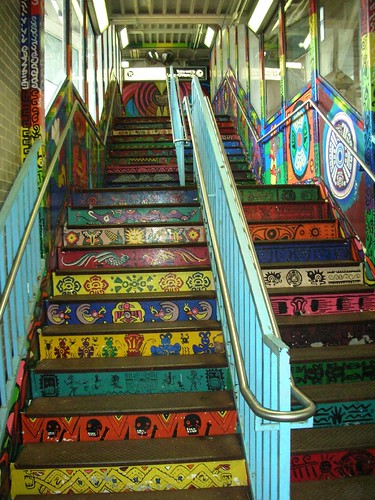
 One of things I like when visiting a metropolis is its diversity: you can have lunch in Chinatown and dinner in Little Italy. Everywhere you walk, diversity surrounds you. I qualify as a 'diversity-seeker', a person who actively looks for diversity.
But what exactly do I do with this diversity? And how does this inclination of seeking diversity translate in terms of social engagement, social practices and social ties?
Well, according to a recent study published in the Journal of Ethnic and Migration Studies, diversity-seeking may translate into ... well, consumption of diversity. But from consumption to engagement with difference it's a big step, one that involves challenging your own routines and values, re-adjusting your own expectations and practices, and striving to open yourself up instead of closing yourself down to difference.
Blokland and van Eijk (2009) have studied the residents of a small neighborhood in Rotterdam (the Netherlands), asking some pre-determined questions on their attitude to and engagement with diversity. The neighborhood in question is an ethnically diverse one, recently transitioning from being perceived as a 'bad' neighborhood to being perceived as a 'cool' one, with small shops and fancy restaurants.
Although the study itself remains limited by the pre-determined set of questions that were asked of people (we do not know how people themselves made sense of their own position in those neighborhoods and their own relation to diversity), it is interesting to see that what diversity-seeking often translates into is consumption:
Diversity-seekers frequented restaurants, bars and shops more intensely than other residents, but did not show more (or less) social or political engagement with local neighbourhood affairs than other residents.
The article itself is responding to Richard Florida's now famous discussion of the rise of a new middle-class, the creative class, roughly defined by its involvement in creative industries. The creative class, Florida contends, is more inclined to be tolerant and to seek diversity in their residential locations. But exactly what does 'seeking diversity' means remains an open question: just because one eats Chinese food and drinks Greek ouzo doesn't necessarily make that person more willing to question hi/er belief system and daily practices. Blokland and van Eijk (2009) echo this when they conclude that
a taste for diversity means little to social network diversity. As far as diversity is brought into the practice of daily life, using cmmercial neighborhood facilities is all that diversity -seekers do more... even for those who, whether middle-class or not, come into a mixed neighborhood with openness to diversity, this openness does not translate in more diverse networks (p. 327).
As I said, there are limitations to this study. In fairness, it sheds little light on how people actually relate to diversity, beyond statistically correlating their demographic data with their answers to some pre-determined questions that the authors take as measuring diversity in our lives. In my building, there are at least three or four recognizable ethnic groups. I do not socialize with my neighbors simply because the way I come to make friends involves an intellectual rapprochement, and it's hard to have that interaction with one's neighbors out of various reasons (including the Western attitude towards sharing an urban space). Yet, the study does bring forward an interesting observation: that consumption of diversity does not equal living with diversity.
Photo credits
Puroticorico
References: Blokland, Talja and van Eijk, Gwen(2009) 'Do People Who Like Diversity Practice Diversity in Neighbourhood Life? Neighbourhood Use and the Social Networks of 'Diversity-Seekers' in a Mixed Neighbourhood in the Netherlands', Journal of Ethnic and Migration Studies, 36: 2, 313 — 332
We classify. Maybe because we want to master the world around us, by putting order into it. Maybe because our brains work with a tree-like structure, placing things into categories and drawing branch like relations between them. We classify, and in this process we buy into the order of things*: we accommodate things within a pre-determined system of beliefs and interests that underlies every classificatory order.
No classification is innocent.
- I'm going to a concert tonight. There's a famous piano-player from Canada playing.
- What's her name?
- Sarah Cheung.
- Oh, she's Asian then.
- She's quite famous in Canada.
- Yes, of Asian origins. Cheung does not sound ... well, how shall i put it, Canadian.
- It may not sound Western.
- Yeah, that's what I meant.
Canadian, Asian, Western... we need to put people in categories. It's not enough to say what a person does or where a person now lives. To properly place that person in our nicely fitting systems of categories, we need to find out "where is s/he coming from". As if, by ticking the little box of birth-place and/ or ethnic group, all of a sudden there's order. And we can breath out, relax and hear the rest of the conversation.
*The Order of Things is the title of one of Michel Foucault's books, dealing with the relation between power and knowledge.
Warning: The following notes smell like middle-class, I-have-it-all, I-can-afford-to-be-cosmopolitan bragging... not my intention, but the smell persists...
 The other day, a friend from Romania asked her network on Facebook to vote for a band in Germany. She's dating one of the members of the band, who's also from Turkey. Funny things is, me and this friend met in Turkey... the Westernized, touristic part of Turkey where people go to forget their frustrations and enjoy life by the sea, sipping on a margarita. That part of Turkey where's water in abundance and where everything is white and neat, just like the tourists... What stayed most with me however was the overwhelming feeling I had stepping into the Istanbul bazaar... Istanbul
Istanbul: There was this person I knew from Istanbul whom I actually met in the subway in Budapest. I was talking to a friend of mine who happened to be from Greece, and just like in a comedy of errors, this guy thought we were talking about him. The friendship between a person from Athens and one from Istanbul, as unlikely as it sounds to some ears, was actually a natural... Friendship
Friendship: So was the friendship between this person from Athens and a person from Skopje. Hey, who would have every thought... There's nothing more powerful in destroying ethnic stereotypes and nationalisms than friendships. The three of us formed a trio, always together - also known as "The Triplets"... Triplets
Triplets: Having triplets is no easy job, but for my friends it looks like a piece of cake. You'd think having three kids at once would transform the mom into a perpetual slave to diapers and baby food. Not this mom... She's just amazing, travelling almost every month to Strasbourg and Bruxelles. Hey, the European Union itself is asking for her! So she goes to beautiful Bruxelles, to mingle with all of those politicians and bureaucrats we only get to see on TV... When we visited Bruxelles, my mom told me: "Look, we are now running around in the backyard of Europe". Not quite a 'backyard', but still a huge, white (here comes whiteness again...) meeting place. A place where my former colleague, who so happens to be from Bulgaria, shops for fine chocolates and gateau aux abricots... Bulgaria
Bulgaria: I owe a huge debt to a person from Bulgaria, who once had faith in me and told me "you can do it". So did a person from Hungary and two from Norway: they gave me courage and skillfully guided me through the jungle of social theory. Theory and morality. Just and unjust wars. Social responsibility and peace. Peace
Peace: Peace is exactly what my friend from Kenya hopes and lives for. But when you work in a conflict area, thousands of miles away from your own family, peace seems like a rich-people privilege... My friend tells surreal stories about kidnappings, gun-attacks and violence. And I can only listen, a world away, hoping somehow nothing will touch my friend and the world will get a better place.... Cheers to bourgeois ignorance... I once had a roommate from that area. I remember she had never seen snow in her life before we were in Norway. But then again, neither did my friend from Athens - though it so happens that after we saw snow in Budapest, Athens all of a sudden started getting snow... Blame it on the climate change. Climate change
Climate change: My friend from Costa Rica keeps a calendar of the days left til the Copenhagen Summit on Climate Change. It's a one-person fight: every day, he reminds all his friends of the summit and of climate change. Every day, he asks us to think about what each and every one of us could do to change things. It's like a daily mantra we came to expect: tell us something about climate change. And it works for us, his friends... Friends
Friends: My friends are spread all over the world. And if I'm to add my acquiantances to my network of friends, I get to cover quite a lot... From Asia to Europe, from Australia to North America, from Africa to ... well, what's left? Hm, no friends from the two Poles, though I can still brag with some friends who live above the Polar Circle...
I went to a see a play the other day. Though marketed as a comedy, the play was in fact quite heavy: troubled relationships, troubled lives and the past haunting the present, delivered to the audience in a funny wrapping. And the thirty-something people in the audience laughed here and there, whenever appropriate. Except one. One person laughed at the... er... wrong times?
You know the type: usually in the middle of the room, this person has obviously got it all wrong. They never laugh when everyone else is laughing; they laugh on their own, as loud as they can, enjoying themselves, oblivious to the annoyance they bring upon you...
What's wrong with them, why don't they get it?
But it's so easy to get annoyed with other people, to see the wrongs in them... If only they would follow the rules... the norms... the conventions...
Because, in the end, that's all it comes down to: rules, norms and conventions. Social rules around what is appropriate behavior during a play. Social cues to be read in the play, in the actors' behavior. Social conventions defining what counts as funny, appropriate, acceptable. And laughing on your own, finding your own relationship to a play and to its meaning, that's just not 'legitimate' with us: you have to laugh when the others are laughing, and you have to clap when the others are clapping...
Have you noticed that nobody - and I mean Nobody! - throws rotten tomatoes at actors anymore? Or that nobody shouts at them "You suck! Find another job!" (only Simon Cowell still has that privilege...)? Oh, that would be funny... I fantasized about that during quite a few performances... but I would never have the courage to break the social rules of legitimate behavior. I missed my chance with some hundred years... ah, the time when audiences chatted during a play (gosh, imagine the disorder!) or when they "hooted and jeered" (Gossett, p. 174).
The unwritten yet powerful rules of politeness and legitimate behavior. We can't do without them (really, don't start throwing rotten tomatoes at people you don't like, ok?). Yet they also hide away the real lines of separation under the veil of 'appropriate behavior'. Separation along class lines or majority/minority lines, when the you just 'know' from a person's reaction that s/he's not 'well-mannered' or 'from here'.
Norms, rules, conventions, symbols, words, ways of talking - all of these form for Pierre Bourdieu the 'symbolic capital' through which we communicate. The currency we use to obtain other people's endorsement, support or even love. They position us in the social hierarchy. Our use of them reveals us as 'insiders' or 'outsiders', as 'powerful' or 'power-hungry'.
"To speak is to appropriate one or other of the expressive styles already constituted in and through usage, and objectively marked by their position in a hierarchy of styles which expresses the hierarchy of corresponding social groups" (Bourdieu, 1991, p. 54)
And it is not only speech - the choice of words, the way you construct a sentence, a.s.o - but also gestures, postures, proximities; we rely on them to communicate with others. They position us in particular nodes of power structures; and we use them as guides in interpreting other people, in positioning them within the social hierarchy.
In fairness, this time I actually enjoyed this lonely audience member's laughter. But most of the times, I resent it. It's hard to move beyond the resentment: it's way easier to study the social norms and their power dimensions than it is to actually live with them. But I suspect the hardship comes from the rather rigid boundary social groups have constructed around them. Any tresspassing of the boundary, of the 'common sense' and 'social expectations' is troubling and distressing. And it's always easier to point to the "Other" as an "Other", than to be suspicious of your own labelling of people. References:
Bourdieu, P. (1991) Language and Symbolic Power. Cambridge: Polity Press
Gossett, P. (2006) Divas and Scholars: Perfoming Italian Opera. University of Chicago Press
 I know someone who didn't get along with their boss. A female boss, I should add. So, when he was fired, he said "I will never work for a chick again". I have to confess this comment stayed with me; its derogatory labeling of women as 'chicks' kept bothering me. Women in power, that's even worse! Chicks in power sounds so much less threatening! Chicks are cute, chicks are innocent, chicks are brainless...
A recent TIME issue was devoted to the the state of women in America today. I didn't know there was no female FBI agent in the early 1970s, when TIME first covered this topic. From the 1970s up to now, there has been quite a change: a quantitative change, with more women taking on jobs as well as claiming decision-making positions, but also a qualitative change, with both men and women complexifying their definition of gender roles and expectations.
There is a gender-related change, no doubt about it. But there must also be a healthy dose of skepticism about the scope and depth of this change. There's little doubt in my mind that there's plenty of men out there, who consciously or not, truly believe there's no way they would 'work for a chick'. Yes, they do need a serious system upgrade; patches won't do. But they are also the fathers raising up the next generation of sons who 'won't work for chicks'. Of sons who won't read 'chick lit' or watch 'chick flicks'.
What on earth is a chick flick anyway? It turns out, the fathers and sons who won't work for 'chicks' also won't study the same 'chick' curriculum. I remember reading about this boys-only school where boys won't be made to read literature targeting girls (translation: anything that deals with nurturing, bonding, raising, problematizing, discussing). 'Cause boys cannot identify with that, they need to identify with trains and cars, with explosions and guns, with the real issues boys face in the real world (yeah, like trains and guns...). As the guy in charge of this school explained, most boys fails school because the curricula is 'girl-oriented'....
Chick flicks, chick lit, chick curricula, and, let's not forget, chicks-in-power. Some things do change, but exactly how deep is this change - and how the change itself is reinterpreted by some groups - remains open for debate. There should be enough reason to stay optimistic, but at the same time, there's plenty of reason to be very cautious.
One of the most important Marxist thinkers, Antonio Gramsci once argued that dominant ideologies - like patriarchy in our case - work through hegemonic processes: they seduce us into consenting to their worldviews as much as they force us. And, when change threatens the worldview that patriarchy proposes, there will always be an attempt to reincorporate that change back into the dominant ideology, by redefining its terms so that they are less threatening. Like calling women chicks. Like re-drawing strong gender lines, where real boys don't cry and definitely don't watch chick flicks. And where chicks themselves reclaim the label for themselves, rejoicing the (questionable and tricky) sexual power a chick has over a man, and calling only on their moms and girlfriends to go out and watch a chick movie (cause you know, my husband doesn't really like chick flicks...).
Photo credits: Dominic
Although I'm finding less and less time to write here, the other today I thought of writing something on this rather disturbing news: apparently, a group of 'concerned Christians' wants a statue of the Hindu god Ganesh removed from the Calgary zoo on grounds that the 'good Christians' are finding it offensive.
As a non-concerned - and obviously not a very good - Christian, I'd like the statue to stay where it is. I can only hope the 'good Christians' are not as successful as they have been in getting an Oppenheim sculpture removed from Vancouver. The historical entitlement that such Christian groups have felt in deciding just what should count as art has been a powerful barrier to both aesthetic diversity and critical thinking. But that was during medieval times, the so-called 'dark ages', where darkness came - at least in part - from religious prohibitions to creativity and knowledge.
But when you see the trace of such controlling attempts today, you cannot help but wonder: who on earth are these people, these 'concerned Christians'? I bet you they look exactly like our next door neighbors: you have no idea what boils underneath their kind appearance... But how do they get so intolerant? What twisted interpretation of Christian doctrine makes them unable to move out of the dark ages? And, most importantly, what is it that they do for a living, since they seem to have a lot of free time on their hands to take up - pardon my French - rather stupid religious crusades...
I once saw a birth depicted in a movie. As a child, the lengthy and painful process made a powerful impact on me: I could never understand why anyone in their right mind would subject themselves to this willingly. That memory stayed with me throughout my adolescence: if there was one thing to be avoided, that was pregnancy. There was always abortion, but that in itself was yet another invasive procedure at the time (plus the social stigma associated with it). Not to mention the whole anguish associated with a mere visit to a gynecologist: I always wondered why nobody would come up with less invasive methods for a checkup. I had a hard time believing that, with all the other non-invasive methods of investigation and even surgery, women's reproductive apparatus could only be properly tended to through invasive methods.
In time, I came to realize that I may be part of the problem too: why did I take it as invasive? What was the root of my horror, disgust and fear with gynecological checkups, pregnancy, abortion? Beyond the sheer fear of pain, a disempowering vision of women's sexuality was lurking behind my understanding of 'being a woman'. After all, it's still called the 'reproductive apparatus' - why not the sexual apparatus? Or the pleasure apparatus? And then again, maybe calling it a 'reproductive apparatus' focuses the medical profession only on its 'reproductive' function, stripping it of any other possible understandings.
What's wrong with reproduction, you'd wonder. Isn't it the most wonderful thing on earth, the possibility to bring someting into being? But 'wonderful' is not exactly the word I'd use: it's part of the cycle of life, I do agree with that. But it's as common as breathing: look around, everything gets to reproduce, then die. There's no transcendental mystery to it. It's intriguing how it happens, but it does happen a lot, on a daily basis, and no other species gets to fuss about it so much as humans do.
And then, maybe that's precisely the problem: that all other living creatures are doing it, but then nobody gets to tell them if they 'should' and how it 'must be done'. Nobody gets to define them as the 'reproductive pool' of the species (well, nobody except humans research them, of course).

 One of things I like when visiting a metropolis is its diversity: you can have lunch in Chinatown and dinner in Little Italy. Everywhere you walk, diversity surrounds you. I qualify as a 'diversity-seeker', a person who actively looks for diversity.


 Posts
Posts


